
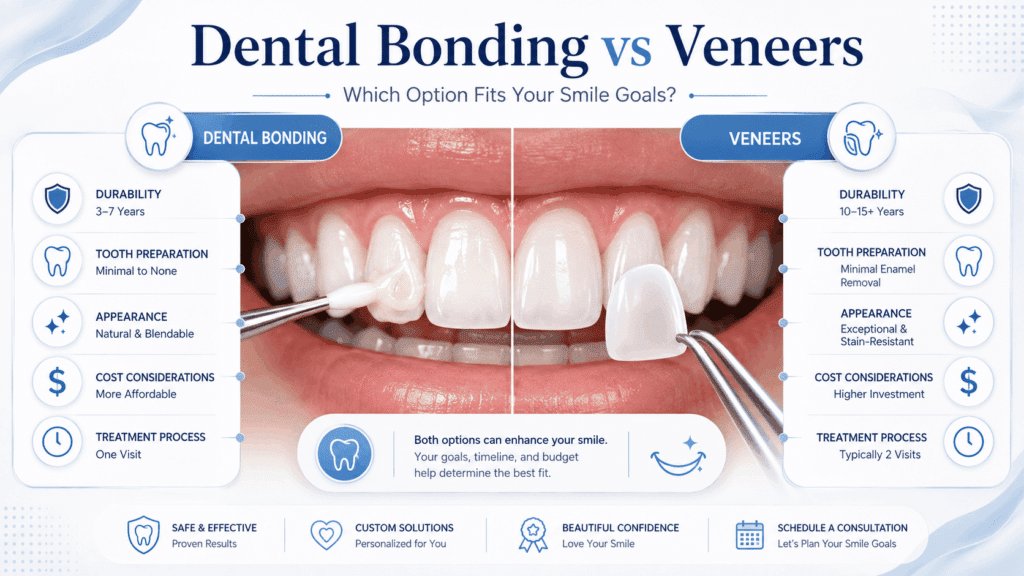
Many people considering a smile makeover end up deciding between dental bonding and veneers. Both can improve chipped, worn, discolored, or uneven teeth, but they aren’t interchangeable. They differ in appearance, durability, tooth preparation, cost, and the types of cosmetic concerns they tend to address best.
Understanding those differences can help you have a more informed conversation with your dentist about which option fits your smile goals.
What Is Dental Bonding?
Dental bonding uses composite resin, a tooth-colored material also used for certain fillings, that a dentist applies directly to the tooth. The dentist shapes the resin by hand and hardens it with a curing light, often completing the treatment in a single visit.
Bonding is generally considered a minimally invasive option because it typically requires little to no removal of existing enamel. Dentists commonly use it to improve the appearance of chipped teeth, small gaps, minor shape concerns, and some stains that whitening may not fully address.
What Are Dental Veneers?
Veneers are thin, custom-made shells that a dentist bonds to the front surface of a tooth to improve its appearance. They are typically made from porcelain or composite resin, and each material comes with different benefits and considerations.
Porcelain veneers generally offer greater durability and stain resistance, while composite veneers often cost less and may require fewer appointments. Our practical guide to porcelain veneers and our overview of composite veneers explain these options in more detail.
To place veneers, a dentist may need to remove a small amount of enamel so the veneer fits properly and blends naturally with the surrounding teeth. Because this process can involve changes to the tooth structure, dentists generally consider veneers a long-term cosmetic treatment rather than a reversible option. Veneers can address several cosmetic concerns, including tooth shape, size, and color, depending on the patient’s needs.
Dental Bonding vs Veneers: Key Differences
The table below summarizes how bonding and veneers typically compare. Actual results vary by patient, material, and clinical circumstances.
| Factor | Dental Bonding | Veneers |
| Material | Tooth-colored composite resin | Porcelain or composite shells |
| Appearance | Natural-looking, though shade and shine may differ slightly from enamel over time | Highly natural-looking, particularly with porcelain; often used for more uniform results |
| Tooth preparation | Minimal to none; little enamel removed | Typically requires removing a thin layer of enamel |
| Durability | Generally less durable; more prone to chipping under heavy bite forces | Generally more durable, especially porcelain, though not indestructible |
| Stain resistance | More prone to staining over time, particularly composite | Porcelain typically resists stains well; composite veneers stain more easily |
| Longevity | Often several years, commonly cited around 3 to 10 years depending on care and habits | Often cited in the 10 to 20 year range with proper care, depending on material |
| Repairability | Usually simple to repair or touch up in one visit | Repairs are more involved and may require replacing the veneer |
| Cost | Generally lower upfront cost per tooth | Generally higher upfront cost, particularly for porcelain |
| Treatment time | Often completed in a single visit | Typically requires two or more visits for preparation and placement |
| Best uses | Minor chips, small gaps, small shape corrections | Multiple cosmetic concerns, larger smile makeovers, more significant discoloration |
Neither option is universally better. Each has situations where it tends to make more sense, which is part of why an individual evaluation matters more than a general rule.
When Dental Bonding May Be the Better Choice
Bonding is often considered a reasonable starting point for minor chips, small gaps, or small corrections to a tooth’s shape. It tends to appeal to younger patients or anyone who prefers a more conservative treatment before committing to something more permanent.
Cost is also a factor for many patients, since bonding generally costs less upfront per tooth than veneers. That said, whether bonding is appropriate for a specific tooth still depends on a clinical evaluation, including bite forces and the extent of the cosmetic concern.
When Veneers May Be the Better Choice
Dentists may consider veneers when patients have multiple cosmetic concerns, are planning a broader smile makeover, or have discoloration that does not respond well to whitening. Veneers may also be an option for teeth with visible wear when a patient wants a more uniform cosmetic result. The best approach depends on the condition of the teeth, the patient’s goals, and what a dentist finds during an evaluation.
For patients weighing a broader transformation, our Woodland Hills veneers page outlines what that process generally looks like from consultation through placement.
Pros and Cons of Dental Bonding
Bonding tends to be less expensive, faster to complete, and more conservative in terms of tooth structure, since it generally preserves most of the natural tooth. It can typically be adjusted or touched up in a single visit if something chips or needs refining.
On the other hand, composite resin is generally less durable than porcelain and can be more prone to staining or chipping over time, particularly for patients who clench, grind, or bite their nails. It may also not hold up as well under heavy bite forces without regular maintenance.
Pros and Cons of Veneers
Veneers, especially porcelain, tend to offer strong durability and stain resistance, along with a more uniform, controlled cosmetic result across several teeth at once. Many patients find the appearance closely resembles natural enamel.
The tradeoffs often include a higher upfront cost, a treatment process that may involve permanent changes to the tooth structure, and more complex repairs if a veneer becomes damaged. In some cases, replacing the veneer may be the recommended option rather than making a simple repair. Veneers also require ongoing care, and patients should understand that they may need replacement in the future.
How Long Do Bonding and Veneers Last?
Bonding is often cited in the range of roughly three to ten years, while porcelain veneers are more commonly cited in the ten to twenty year range. These figures are general references rather than guarantees, and actual results vary widely based on oral hygiene, diet, grinding or clenching habits, bite forces, and how consistently a patient keeps up with maintenance and dental visits.
According to the American Dental Association, certain habits, like biting fingernails, chewing on hard objects, or frequent exposure to staining foods and drinks, can affect how well a veneer holds up over time. The same general principle applies to bonded teeth.
Can Bonding Be Replaced With Veneers Later?
Some patients choose bonding first because it offers a more conservative way to improve their smile. If their goals change later, or if the tooth needs a different type of correction, they can discuss whether veneers may be an appropriate option. The right approach depends on the condition of the tooth, the reason bonding was originally chosen, and the patient’s overall goals. A dentist can evaluate whether a tooth with existing bonding may be suitable for veneers in the future.
How to Decide Which Option Is Right for You
Dentists typically weigh several factors together rather than looking at cost or appearance alone. This usually includes your smile goals, the current condition of the tooth structure, your bite, habits like grinding or clenching, budget, and overall oral health.
Because these factors interact, the right option for one patient may not be the right one for another, even if the cosmetic concern looks similar on the surface. That’s part of why a personalized evaluation tends to lead to a more predictable outcome than choosing based on general information alone.
Choosing a Cosmetic Dentist in Woodland Hills
Dr. Pearl Zadeh works with Woodland Hills patients considering both dental bonding and veneers, helping them choose an option based on their individual smile goals rather than a one-size-fits-all approach. She discusses the benefits and limitations of each treatment, explains what patients can realistically expect, and recommends conservative options when they make sense. If you’re also considering whitening as an alternative or addition to cosmetic treatment, our guide on veneers vs teeth whitening covers how these options compare.
For patients specifically comparing veneer materials, porcelain vs composite veneers covers that decision in more depth. You can also learn more about cosmetic dentistry with Dr. Pearl Zadeh in Woodland Hills and the range of options available beyond bonding and veneers.
Schedule a Cosmetic Consultation With Dr. Pearl Zadeh
Choosing between dental bonding vs veneers usually comes down to your specific goals, tooth structure, and budget, not a one-size-fits-all answer. The most reliable way to figure out which fits your smile is a personalized evaluation rather than assuming one option is right before your teeth are actually examined.
Dr. Pearl Zadeh and her Woodland Hills team can walk you through both options, explain realistic expectations for each, and recommend a conservative starting point where appropriate.
Call (818) 716-6722 or click the button below to schedule your cosmetic consultation online.
Schedule a ConsultationFrequently Asked Questions
1. Is dental bonding cheaper than veneers?Generally, yes. Bonding typically costs less per tooth upfront than veneers, particularly porcelain. Actual pricing depends on the number of teeth involved and the complexity of the case.
2. Does dental bonding look as natural as veneers?Dental bonding can create a natural-looking improvement, especially for smaller cosmetic corrections. However, composite resin may not replicate the shine and translucency of natural enamel as closely as porcelain, particularly over time. Many patients achieve satisfying results with bonding when it matches their specific needs and expectations.
3. Which lasts longer, bonding or veneers?Porcelain veneers generally last longer than dental bonding. Dental bonding often lasts around 3 to 10 years, while porcelain veneers commonly last 10 to 20 years or longer with good care. However, lifespan varies based on factors such as oral hygiene, bite habits, and everyday wear, so your dentist can give you a more personalized expectation.
4. Do veneers damage teeth?Placing veneers typically involves removing a thin layer of enamel, which makes the process not considered reversible. When performed appropriately, this is a standard part of the process rather than damage, though it’s a permanent change worth understanding beforehand.
5. Is bonding reversible?Dentists often describe bonding as a minimally invasive treatment because it usually requires little to no enamel removal. However, it isn’t always fully reversible in every case. Your dentist can explain what applies to your specific tooth.